.svg)

Your AI does sharp analysis and knows nothing about your business. Here is how to fix that in an afternoon, with one repo and one prompt.
I have spent the last year watching teams point an AI at their analytics, and the results land in two camps. Either the model asks for context it does not have and stalls, or it does not ask, and hands back a confident answer built on guesses about how your business works. The second one is the dangerous one, because it looks finished.
The pattern underneath is the same every time. The model is genuinely good at the analysis. It is bad at knowing your company. It does not know your ICP, your north-star metric, the three experiments you already ran and killed, or which number on the dashboard actually moves revenue. So you re-brief it every session, paste in whatever context you happened to remember that morning, and the ceiling on every answer is set by how good your paste was. That is a tax you pay forever, and it scales with nothing.
There is a fix, and it is unglamorous. Write your company down once, in one place your team and your agents both read. Plain markdown, in a Git repo. The kind of thing a person edits in two minutes and an AI reads in full before it says a word, which is more than you can say for the deck buried in someone's Downloads folder or the Notion page that went stale at the last reorg.
What the difference looks likes
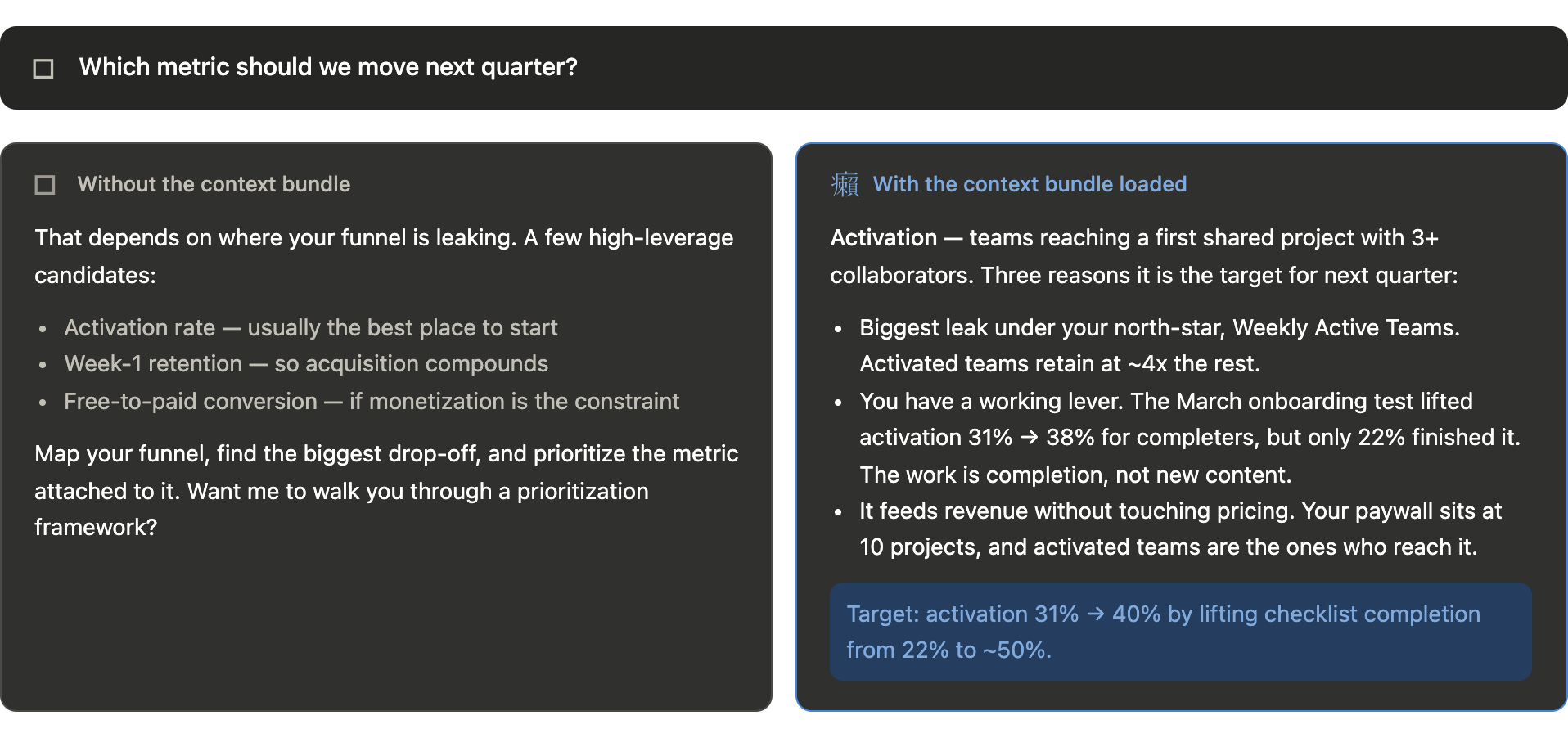
Ask an AI "which metric should we move next quarter" cold, and you get a competent textbook answer about activation and retention, useful to nobody who actually works at your company. Ask the same question with your context loaded, and it answers in your terms: your north-star, the input metric it decomposes into, the experiment you ran on that input in March, the usage threshold where you start charging. One reads like a consultant who flew in this morning. The other could have come from someone on your own team.
What goes in it
Eight areas. Company, product, audience, market, motion, metrics, analytics, reference. Mission and positioning at the top. The ICPs you actually sell to and the jobs they hire your product to do. Your metric tree as the centerpiece: the real decomposition from the inputs you control down to the revenue you report, written out, with the relationships between the numbers named rather than implied. How you grow, and how you genuinely run experiments at your current size, not how a 200-person growth team does it. The events you track and where each metric is read. And a glossary, so the AI resolves "activation" the way your company means it instead of inventing a definition.
One concept per file, plain markdown, folders numbered so the whole thing reads top to bottom like a story about the business.

How to build it
You do not write this from a blank page, which is the part that kills most documentation efforts before they start. You clone a template and let the AI interview you. An afternoon, most of it spent talking.
- Clone the template. Hit "Use this template" on the starter repo and you have your own copy, every file already stubbed with the question it wants answered.
- Connect it to Claude. Open the repo in Claude Code, or hand Claude the files directly. Now the AI can read the structure and write into it.
- Run the interview. Paste the prompt below. Claude works through about twenty questions across the eight areas, one at a time, pushes back when you give it something vague, and writes each answer into the right file in the right format. Twenty minutes of talking where you would otherwise have lost a weekend to writing.
- Keep the log alive. As you ship and learn, write decisions and experiment results into log.md. The next analysis starts from what the last one learned instead of from zero. The repo gets sharper every week, and so does every answer that leans on it.
The prompt
Copy this into Claude with your cloned repo open.
"You are interviewing me to build my company's context bundle — a set of markdown files that any AI agent reads before doing analytics, growth, or experimentation work for us. The blank structure is in this repo: eight numbered folders (01-company through 08-reference), each holding concept files that have prompts at the top. Your job: interview me, then write my answers into those files in the same format. Keep the type frontmatter, replace the prompt block with real content.
How to run it:
- Go area by area, in folder order: company, product, audience, market, motion, metrics, analytics, reference.
- Ask one focused question at a time. Wait for my answer. If it is vague or generic, push back once and ask for the specific, the real number, the actual example. Do not accept fluff.
- Keep it tight: two or three questions per concept, around twenty in total.
- After each area, write the files for it, show me what you wrote, and confirm before moving on.
- At the very end, add a one-line "initialized from interview" entry to log.md.
Rules for what you write:
- Concrete over abstract. Name the thing, use real figures.
- Short. Every line earns its place. One idea per sentence.
- Match each file's existing structure and type. Cross-link related files with relative links.
- If I do not know something yet, write TODO: with the open question rather than inventing an answer.
Start by asking me the first question for 01-company/mission.md. Do not summarize this prompt back to me. Just begin.
You will resist this
I did, and the reasons are predictable. Worth naming them, because each one has a quiet answer.
"It will go stale." Yes, the moment you stop feeding it. That is exactly what the log is for, and writing a two-line decision after you ship is the cheapest habit on this list. A bundle nobody updates is a dead document. A bundle wired into how you close out work stays current on its own.
"We already have this in Notion." Maybe you do. But your agent cannot read it cleanly, your team does not version it, and nobody is quite sure the page is still true. Plain files in Git fix all three in one move, and you keep Notion for the humans who like it.
"Our business is too complex for a few text files." Most of that complexity, when you sit down to write it, turns out to be vagueness wearing a suit. The interview is uncomfortable for exactly this reason. It will not let you say "we focus on quality" and move on. It asks which number tells you quality went up, and you either have one or you have just learned something about your own company.
What changes once it exists
The bundle is portable, which is the whole point. The same files feed Claude, feed an Amplitude MCP that reads your context before it queries your data, feed whatever model ships next quarter. You write your company down once and every tool you adopt afterward inherits it.
Three things change in practice. Your agents stop guessing, because the guess is now on the page where you can correct it. A new hire gets handed the repo and is useful by Thursday instead of by next quarter. And the log compounds: every experiment result you write down makes the next experiment design a little less naive, which over a year is the gap between a team that learns and a team that keeps rediscovering its own dead ends. You stop being the bottleneck that every good analysis has to route through you to become any good.
Start
Clone the template, paste the prompt, answer the questions honestly. Then point your next analytics or experimentation task at the repo and watch the first answer come back in your own language. Template and prompt are here: github.com/Adasight-Workspace/context-bundle-starter.
Adasight helps product and growth teams turn their data into revenue. We build the context layer, the metric trees, and the experimentation programs that make AI analytics actually fit the business it is working for.


.png)