.svg)

Statsig is a feature flagging and experimentation platform built by ex-Facebook engineers that lets product teams control who sees what in their product, run A/B tests with statistical rigour, and measure the impact of every change. Amplitude is the leading product analytics platform for understanding user behaviour, retention, and conversion. Used together, they form one of the most powerful product intelligence stacks available. Statsig controls what ships and measures whether it worked, Amplitude provides the full behavioural context around those results. This guide covers what Statsig is, how it connects to Amplitude, and when to use each tool.
Two searches are surging right now: "what is Statsig" and "Statsig Amplitude."
Both point to the same question product and growth teams are asking: what exactly is Statsig, how does it fit into a modern product stack, and specifically how does it work alongside Amplitude?
This article answers all three.
What Is Statsig?
Statsig is a feature flagging, experimentation, and product analytics platform. It was founded in 2021 by engineers who built the internal experimentation infrastructure at Facebook, the system that ran tens of thousands of experiments simultaneously across Facebook, Instagram, and WhatsApp.
That heritage is visible in the platform's statistical depth. Statsig supports sequential testing, CUPED variance reduction, holdout groups, and guardrail metrics out of the box, with capabilities that most experimentation tools either do not offer or offer only on enterprise plans. It is built for teams that take statistical rigour seriously and need their experiment results to be genuinely reliable.
Statsig has three core capabilities: feature flags for controlled rollouts, A/B testing and experimentation for measuring the impact of changes, and product analytics for understanding how users interact with your product. It is one of the few platforms that combines all three natively, which is why it is increasingly being evaluated alongside Amplitude rather than just as an alternative to LaunchDarkly or Optimizely.
Most recently, Statsig joined OpenAI, a move that has significantly raised its profile and is behind much of the current search surge. The acquisition signals a major investment in AI-powered experimentation infrastructure at scale.
What Is Amplitude?
Amplitude is the market-leading product analytics platform for growth-stage and enterprise SaaS. It tracks how users interact with your product at the event level, what they clicked, which features they used, where they dropped off, how they retained over time.
Amplitude's core strengths are funnel analysis, retention analysis, cohort analysis, and user journey mapping, the analytical methods that connect product behaviour to business outcomes. It also offers native experimentation through Amplitude Experiment (both Web Experiment for no-code marketing site tests and Feature Experiment for server-side product tests), and a growing AI layer through Dashboard Agents and Chat that lets teams ask questions in natural language and get charts and analyses in response.
How Statsig and Amplitude Work Together
Statsig and Amplitude are complementary tools, not alternatives. They serve different but connected purposes in a product intelligence stack.
Statsig handles the control and measurement layer. You use Statsig to decide who sees a feature, when they see it, and in what configuration. Statsig measures whether the change produced a statistically significant improvement in your defined metrics. Its statistical engine: sequential testing, CUPED, holdout groups, makes those results reliable.
Amplitude handles the behavioural context layer. You use Amplitude to understand the full picture of how users behave around that change, not just whether the primary metric moved, but what happened to retention, engagement, and downstream behaviour for the users who were exposed to the variant.
The integration between the two closes the gap between experiment results and product understanding. When Statsig sends experiment assignment data to Amplitude as user properties, you can segment any Amplitude chart by which variant a user was in. This means you can answer questions that neither tool can answer alone: did the users who saw variant B retain better at day 30? Did the feature change affect how users engaged with other parts of the product? Which user segments responded most positively to the change?

How to Connect Statsig to Amplitude
The integration works by sending Statsig experiment exposure data to Amplitude as user properties. When a user is assigned to an experiment variant in Statsig, Statsig fires a tracking callback that sends the experiment name and variant assignment to Amplitude using the identify method.
Your developer implements this using Statsig's trackingCallback in the SDK configuration -- a code snippet that calls amplitude.identify() with the experiment name and variant value as a user property. Once implemented, every Amplitude analysis can be segmented by Statsig experiment assignment.
This setup requires correct SDK implementation on both sides. The most common issues are the tracking callback not firing consistently, user identity not being resolved correctly between Statsig and Amplitude (meaning the same user appears as different users in each tool), and experiment properties not being passed with the correct naming convention for easy filtering in Amplitude.
A Statsig audit is the fastest way to identify whether your current setup is sending data to Amplitude correctly and whether the integration is producing reliable results.
When to Use Statsig, When to Use Amplitude Experiment
This is the question most teams evaluating both tools want answered. Here is the honest framework.
Use Statsig when experimentation is the primary use case and you need best-in-class statistical depth. Sequential testing, CUPED, holdout groups, and guardrail metrics are more mature in Statsig than in Amplitude Experiment. If you are running a high-velocity experimentation programme where statistical reliability is non-negotiable, Statsig's experimentation layer is stronger.
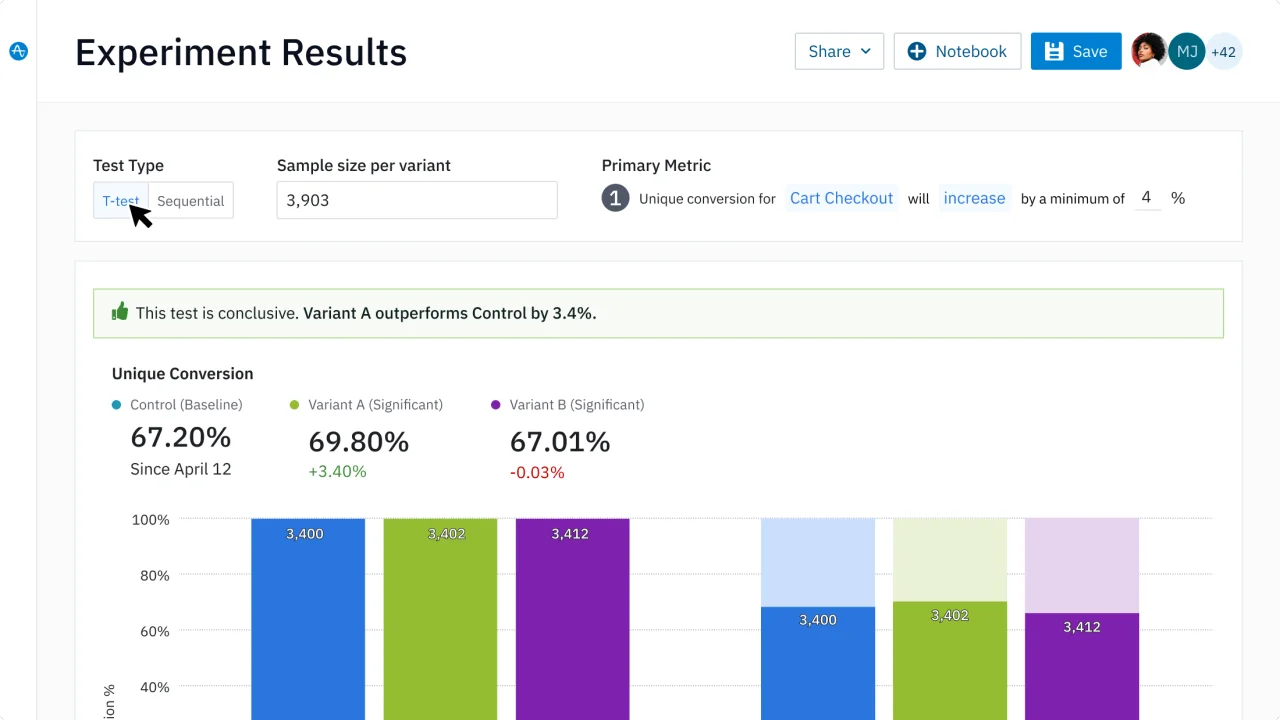
Use Amplitude Experiment when you are already deeply invested in Amplitude and want the simplest possible path to connected experiment results. Amplitude Experiment's native integration means experiment results appear directly in your Amplitude dashboards without any additional data pipeline. For teams running a moderate number of experiments and already using Amplitude as their analytics source of truth, the native integration often outweighs Statsig's statistical advantages.
Use both when you need Statsig's statistical depth and Amplitude's analytical breadth. This is the most powerful combination, Statsig runs the experiments with rigour, Amplitude provides the full behavioural context. The integration described above connects the two.
What the Statsig and Amplitude Stack Looks Like in Practice
A typical product team running the Statsig and Amplitude stack together operates like this.
A new feature is built and wrapped in a Statsig feature flag. It is rolled out to 1% of users first, Statsig monitors for errors and unexpected behaviour. If clean, the rollout expands to 10%, then 50%, then 100%.
Before the full rollout, a Statsig experiment is set up to measure the impact. Users are randomly assigned to control (no feature) or variant (feature enabled). Statsig tracks the primary metric (activation rate, conversion, revenue per user) and guardrail metrics (retention, support ticket volume) using sequential testing so the team can monitor results without inflating false positive rates.
In parallel, Amplitude receives the experiment assignment data as user properties. The product team builds an Amplitude analysis segmented by variant, looking at retention curves, feature adoption patterns, and downstream product behaviour for each group. The combination gives them both the controlled experiment result and the full behavioural story around it.
When the experiment concludes, Statsig declares a winner based on statistical significance. The Amplitude analysis provides the context that makes the decision defensible, not just "variant B converted better" but "variant B users retained 12% better at day 30 and engaged more deeply with three other core features."
That is the difference between a statistically significant result and a genuinely understood one.
Who Should Consider the Statsig and Amplitude Stack
This combination is most valuable for product and growth teams at growth-stage SaaS companies with at least 20,000 monthly active users who are running or want to run a serious experimentation programme. Teams that need both the statistical rigour to trust their experiment results and the analytical depth to understand the full impact of their changes.
If you are earlier stage and running your first experiments, starting with Amplitude Experiment and expanding to Statsig when you need more statistical depth is a reasonable path. If you are already running experiments in Statsig but not connecting results to Amplitude for deeper analysis, the integration described above is a high-value addition to your current setup.
Get the full Statsig 101 Getting Started Guide
The Statsig 101 guide covers the complete setup process in detail like SDK selection, environment configuration, event instrumentation, identity resolution, feature flags, and experiment setup, with worked examples and a setup checklist you can follow step by step.
👉Download the free Statsig 101 Getting Started Guide
See how Adasight implemented Statsig for a real product team
Unravel needed Statsig set up quickly and correctly, right SDKs, clean event taxonomy, properly configured experiments. Adasight delivered a complete audit, live best practices session, and findings document in two weeks.
👉Read the Unravel Statsig case study
Want help setting up Statsig and Amplitude together?
Getting the integration right from identity resolution, tracking callbacks, experiment property naming, is what makes the combined stack actually work. Book a free call and we will review your setup.
FAQ
What is Statsig used for?
Statsig is used for feature flagging, A/B testing, and product analytics. It lets product and engineering teams control who sees a feature and when, run controlled experiments to measure the impact of product changes with statistical rigour, and analyse product behaviour -- all from a single platform. It is particularly strong for teams that need advanced statistical methods like sequential testing and CUPED variance reduction.
How does Statsig work with Amplitude?
Statsig sends experiment assignment data to Amplitude as user properties using a tracking callback in the Statsig SDK. When a user is assigned to an experiment variant, Statsig fires an Amplitude identify call with the experiment name and variant as user properties. This allows any Amplitude analysis to be segmented by Statsig experiment assignment -- connecting controlled experiment results to full behavioural context.
Is Statsig better than Amplitude for experimentation?
Statsig's experimentation layer is more statistically mature than Amplitude Experiment -- sequential testing, CUPED, and holdout groups are more developed. For teams running high-velocity experimentation programmes where statistical reliability is the priority, Statsig's experimentation capabilities are stronger. For teams already deeply invested in Amplitude who want the simplest path to connected experiment results, Amplitude Experiment's native integration often outweighs the statistical advantage.
Why is Statsig trending right now?
Statsig's recent acquisition by OpenAI has significantly raised its profile in the product and engineering community. The move signals a major investment in AI-powered experimentation infrastructure and has driven a surge in searches for information about the platform, its capabilities, and how it fits into modern product stacks.
Do I need both Statsig and Amplitude?
Not necessarily -- but the combination is powerful for teams that need both statistical rigour in experimentation and deep behavioural analytics. Statsig handles experiment assignment and statistical analysis. Amplitude handles full product behaviour analysis. Used together they answer questions neither tool can answer alone. Teams earlier in their analytics journey often start with one and add the other as their programme matures.
What is the difference between Statsig and LaunchDarkly?
LaunchDarkly is primarily a feature flagging platform with experimentation added on. Statsig is built as a combined feature flagging, experimentation, and analytics platform from the ground up. Statsig is generally the stronger choice for teams that want statistical experimentation capabilities -- including sequential testing, CUPED, and holdout groups -- built natively into the same tool as their feature flags. LaunchDarkly is stronger for enterprise teams that need robust, scalable feature flag management as the primary use case.


.png)