.svg)

The Data Foundation No One Owns: Why Ecommerce Teams Can't Trust Their Numbers
Every scaled ecommerce brand has a version of the same meeting. Marketing quotes one revenue number, analytics quotes another, finance has a third, and twenty minutes disappear arguing about whose is right instead of deciding what to do. The reason isn't that anyone's bad at their job. It's that the work underneath all those numbers — clean tracking and one shared definition of revenue — belongs to no one. It's the most valuable work in the building and the most reliably orphaned. This is about why that happens, and what it costs.
The short version: In most ecommerce companies, the most important data work — clean tracking and one shared definition of revenue — has no clear owner, because it sits between marketing, analytics, and engineering. Each team assumes another handles it, so it gets deferred indefinitely, and every downstream number inherits the gaps. The result: platform reports that don't reconcile, a "revenue" figure that means something different to each team, and decisions made on data no one fully trusts. It's the highest-leverage, lowest-glamour work in the building — and it's the foundation everything else (attribution, experimentation, AI) is built on, or built on sand.
The orphaned foundation
Here's the structural problem. The foundational data work — instrumenting events cleanly, agreeing what counts as "revenue," keeping tracking accurate as the site changes — doesn't sit squarely in any one team's job description:
- Marketing needs the reports, but wants outcomes and campaigns, not to own event schemas and tracking plans.
- Analytics interprets and reports on whatever data exists, but often doesn't control how it's collected at the source.
- Engineering ships product features against a roadmap; tracking is rarely on it, and analytics instrumentation is the first thing cut when a deadline looms.
So the work falls into the gap between the three. Everyone assumes someone else has it. No one is measured on it. And because it's invisible when it's working and only painful when it's broken, it gets deferred — sprint after sprint — until a number doesn't add up and everyone discovers, too late, that the foundation was never solid.
What "no owner" actually produces
An unowned foundation doesn't announce itself; it shows up as a slow accumulation of numbers you can't quite trust:
- Reports that don't reconcile. GA4, your ad platforms, and your backend each tell a different revenue story, and no one can say which is right — because no one owns reconciling them.
- Multiple definitions of "revenue." Marketing counts one thing, finance another; gross vs. net, pre- vs. post-refund, when a subscription counts. Without one agreed definition, every cross-team number is a translation problem.
- "Direct" traffic ballooning as UTM tagging drifts and referrers get lost, hiding where demand actually comes from.
- Events that break silently. A site update quietly breaks a tag, and no one notices for weeks because catching it is nobody's job — so the data has a hole that every downstream report inherits.
Individually, each looks minor. Together, they mean nearly half your decision data can't be fully trusted — Adverity's 2025 research found CMOs estimate around 45% of the data behind their marketing decisions is unreliable, with no CMO rating their data more than 75% reliable. That's not a tooling failure. It's an ownership failure.
Why this is the highest-leverage work you're not doing
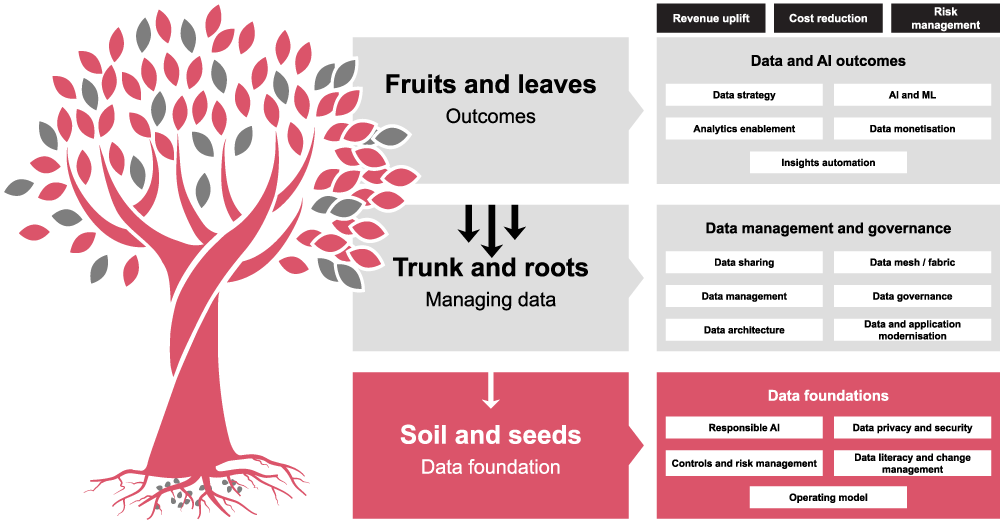
Here's what makes the orphaned foundation so expensive: everything is built on it. Your attribution, your experimentation, your dashboards, and increasingly your AI all inherit the quality of the data underneath them. If the foundation is shaky:
- Your attribution misdirects budget, because it's built on tracking you can't trust.
- Your experiments produce false winners, because you can't tell what actually moved.
- Your AI scales the errors faster, because it amplifies whatever it's fed.
The flaw compounds up the stack. Which means the foundation is simultaneously the least glamorous work — no one gets promoted for defining "revenue" — and the highest-leverage, because fixing it multiplies the value of everything above it. Skip it and you're not saving effort; you're guaranteeing that every downstream investment partially fails. As the saying goes: everything else is built on this, or built on sand.
Why it stays deferred
If it's so valuable, why does it keep getting skipped? Three reasons, all organizational rather than technical:
- It's invisible when it works. A solid foundation produces no visible win — things just quietly add up. So it never competes well against a shiny new feature or campaign for priority.
- It has no single owner. Cross-functional work with no owner is work that doesn't happen. Everyone's contribution is partial, so accountability evaporates.
- No one measures its cost. Because the damage is spread invisibly across every decision, the price of not doing it never lands as a line item — so there's no forcing function to fix it.
The trap is that the foundation looks fine right up until it doesn't, because the dashboards keep loading even when the numbers inside them are wrong.
The fix: give it an owner and one definition of revenue
The solution is disarmingly concrete: someone owns the data foundation, there's one agreed definition of revenue (and every other key metric), and tracking is clean enough that you'd trust it enough to cut spend based on it. That's the bar — not "good enough for a dashboard," but "good enough to bet the budget on." Getting there means a real tracking plan, validated events, and a single source of truth that the whole company reconciles to, underpinned by disciplined event tracking that doesn't silently drift.
The payoff is direct. In one engagement, unifying a brand's data pipeline across GA4, ad platforms, and email — one trustworthy definition of the numbers — was the groundwork that enabled reallocating budget for a 15% revenue lift in nine months, without raising ad spend. The foundation wasn't the glamorous part. It was the part that made the glamorous part possible.
See where your foundation is leaking
If the "whose number is right?" meeting sounds familiar, the honest first step is to find out how deep the foundation problem goes. Adasight's free Growth Gap Assessment scores your maturity across data, experimentation, and AI in about three minutes — no email needed to see your result — and pinpoints your single biggest gap. And for the full picture of how scaled ecommerce brands close these leaks, our ecommerce growth page lays out the operating model that hands your team the keys.
See where your revenue is leaking →
Frequently asked questions
Why can't my ecommerce team agree on revenue numbers?
Usually because there's no single agreed definition of "revenue" and no owner of the underlying tracking. Marketing, analytics, and finance each count it slightly differently (gross vs. net, pre- vs. post-refund, when it's recognized), so every cross-team number becomes a translation problem. Fixing it starts with one shared definition everyone reconciles to.
Who should own the data foundation?
It needs a clear, named owner rather than being split across marketing, analytics, and engineering — because cross-functional work with no owner is work that doesn't get done. The owner is accountable for a tracking plan, validated events, and one definition of each key metric, so the foundation stays trustworthy as the business changes.
Why does the data foundation always get deferred?
Because it's invisible when it works, has no single owner, and its cost is never measured. It produces no visible win, so it loses priority to features and campaigns — and since the damage from skipping it is spread across every decision rather than showing up as one line item, there's no forcing function to fix it.
How does a weak data foundation affect the rest of my analytics?
Everything above it inherits the flaw. Attribution misdirects budget, experiments produce false winners, and AI amplifies the errors — all because they're built on tracking that can't be trusted. That's why the foundation is the highest-leverage work: fixing it multiplies the value of everything built on top.
What does "good enough" data actually look like?
The practical bar is tracking clean enough that you'd trust it enough to cut spend based on it — not just "good enough to fill a dashboard." That means one agreed definition of each key metric, a documented and owned tracking plan, and validated events that don't silently break when the site changes.
.png)