.svg)

The 70% Problem: Why Ecommerce Carts Get Abandoned (and How to Recover the Revenue)
Roughly seven out of ten people who add something to their cart leave without buying. It's one of the most stable numbers in ecommerce — and one of the most misunderstood. Treated as a single scary statistic, "70% abandonment" is paralyzing. Broken down properly, it points to a specific, recoverable pile of revenue you've already paid to acquire — leaking out at the very last step. This article covers what the 70% actually is, why shoppers really leave, and how to win back the part that's winnable.
The short version: Around 70% of ecommerce shopping carts are abandoned — 70.22% on average, per Baymard Institute's meta-analysis of 50 studies, a figure that's barely moved in a decade. But not all of it is recoverable: roughly 43% of abandonment is people browsing with no real purchase intent. The rest abandon for fixable reasons — unexpected extra costs at checkout, forced account creation, a long or complicated checkout, and trust concerns. That's revenue you already paid to acquire, leaking at the final step, and the way to recover it is better checkout design validated through experimentation — not more ad spend.
What the 70% actually is
First, the number is real and remarkably durable. Baymard Institute's aggregate of 50 separate studies puts the average cart abandonment rate at 70.22%, and it's held between roughly 69% and 71% since 2014 — despite a decade of better payment tech and checkout tools. (It runs higher on mobile, around 80%, and lower on desktop.)
But here's the reframe that matters: not all of that 70% was ever going to buy. Baymard's own survey data attributes about 43% of abandonment to people browsing with no purchase intent — window shopping, comparing prices, saving items for later. A near-70% rate, on its own, is not proof of a broken checkout. So stop trying to drive abandonment to zero; that's impossible. Focus instead on the sizable remainder: shoppers who did intend to buy and abandoned anyway because something in your checkout got in the way. That's the recoverable revenue, and it's large.
Why shoppers actually abandon (the fixable reasons)
Among shoppers who abandon for reasons other than browsing, Baymard's research documents a consistent short list — and every one is a lever you control:
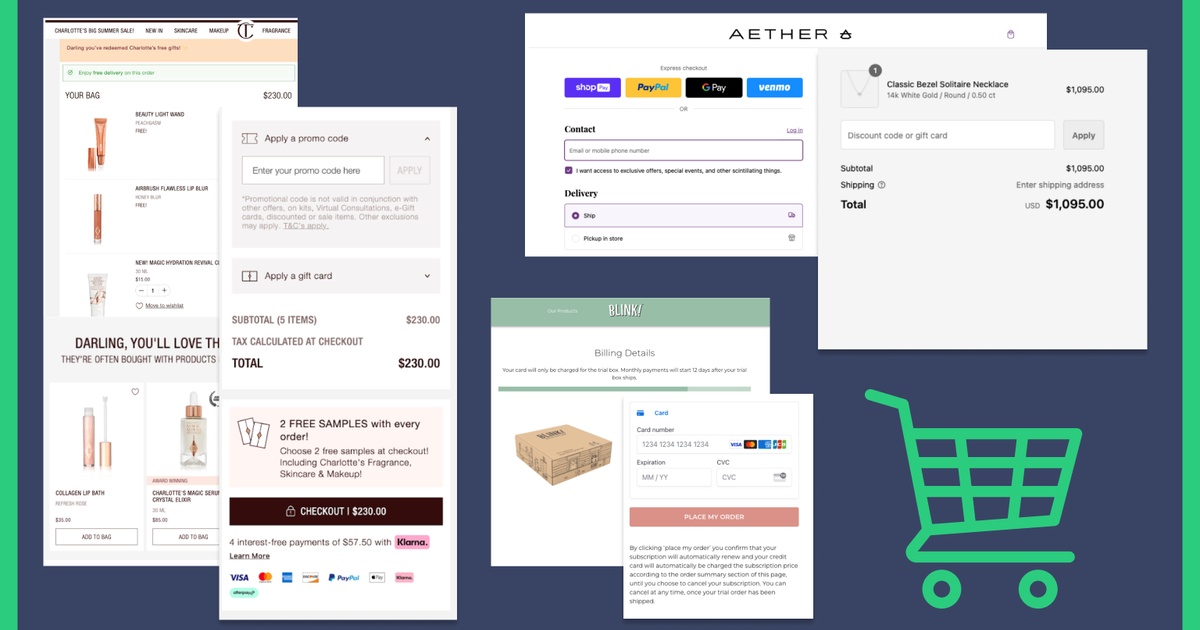
- Unexpected extra costs. The single biggest removable cause — around 48% abandon when shipping, taxes, or fees make the total jump at the final step. Surprise costs at checkout are the number-one leak.
- Forced account creation. Requiring signup before purchase drives a meaningful share away. Many shoppers just want to buy, not join.
- A long or complicated checkout. The average checkout has far more form fields than necessary (Baymard finds around 24 on average versus an ideal of 12–14). Every extra field is friction.
- Trust and security concerns. Shoppers who don't trust the site with their card details leave — missing trust signals, an unpolished checkout, or unclear security all contribute.
- Slow delivery or a slow site. Delivery that's too slow, or pages that load too slowly, quietly cost conversions.
Notice these aren't marketing problems — they're checkout experience problems. The customer already wanted to buy; the checkout talked them out of it.
Why this is the highest-leverage revenue you have
Recovering abandoned-cart revenue is uniquely efficient because you've already paid to acquire these shoppers. They saw the ad, clicked, browsed, chose a product, and added it to the cart. Every dollar of acquisition cost is already spent — the only thing standing between you and the sale is the last few steps. Recovering it requires no new ad spend, which makes it far cheaper than buying more traffic to compensate for a leaky checkout.
The scale is real: Baymard estimates roughly $260 billion in lost orders is recoverable in the US and EU alone through better checkout flow and design, and that fixing documented checkout issues can lift conversions by up to ~35%. For an individual brand, this is often the highest-ROI work available — and it's sitting at the bottom of a funnel you're already paying to fill.
Why you can't just copy "best practices", you have to test
Here's the trap. The causes above are well-documented, so it's tempting to copy a checklist of checkout "best practices" and assume you've fixed it. But checkout behavior is specific to your customers, products, and price points — a change that lifts conversion on one store can flatten it on another. The only way to know whether a fix actually works for you is to test it on your own traffic.
And this is where most brands leave money on the table: they either don't test, or they test far too slowly. Even at elite programs, most experiments don't win — analyses of large experiment datasets put A/B test win rates around 10–12% — which means the path to recovered revenue isn't one clever guess, it's velocity and rigor: running enough well-designed tests, fast, to find the changes that genuinely move your checkout. Testing slowly, on data you can't trust, compounds the loss. (Solid A/B testing practices are what keep those tests trustworthy.)
The recovery playbook
Put together, recovering cart revenue is a loop, not a checklist:
- Find where the leak is. Use funnel analysis to pinpoint exactly which step — cart to checkout, shipping, payment — bleeds the most. Often the biggest leak isn't the final click; it's cart-to-checkout.
- Diagnose why users drop. Watch where real shoppers hesitate, rage-click, or bail. Understanding why your users are frustrated turns a vague "checkout is leaky" into a specific, testable hypothesis.
- Test the fixes on your traffic. Show all costs upfront, offer guest checkout, cut form fields, add trust signals, speed up the page — but validate each as an experiment rather than shipping it on faith.
- Capture and repeat. Ship what wins, learn from what doesn't, and keep the loop running. Recovered revenue compounds as you go.
Cart abandonment is one leak of three
Revenue trapped in the funnel is one of three places scaled ecommerce brands quietly lose revenue — alongside attribution you can't defend and a data foundation no one owns. They compound: if your data can't be trusted, you can't even tell which checkout tests are working, so the leak stays open.
If some of the 70% you're losing is the recoverable kind, it's worth seeing where your revenue is leaking across all three. Adasight's free Growth Gap Assessment scores your maturity across data, experimentation, and AI in about three minutes — no email needed to see your result — and for the full picture of how scaled ecommerce brands recover this revenue, our ecommerce growth page lays out the operating model.
See where your revenue is leaking →

Frequently asked questions
What percentage of ecommerce carts are abandoned?
About 70% — 70.22% on average, based on Baymard Institute's meta-analysis of 50 studies. The figure has stayed between roughly 69% and 71% since 2014. It's higher on mobile (around 80%) and lower on desktop, so your blended rate depends on your traffic mix.
Is a 70% cart abandonment rate bad?
Not on its own. Roughly 43% of abandonment is people browsing with no purchase intent — window shopping and price comparison — which you can't and shouldn't try to eliminate. What matters is the recoverable portion: shoppers who intended to buy but abandoned over fixable checkout friction.
Why do shoppers abandon their carts?
For those who intended to buy, the top documented reasons are unexpected extra costs at checkout (the biggest), forced account creation, a long or complicated checkout with too many form fields, trust and security concerns, and slow delivery or page speed. Each is a fixable checkout-experience issue, not a marketing one.
How do you reduce cart abandonment?
Show all costs upfront, offer guest checkout, shorten the checkout form, add clear trust signals, and speed up your pages — but validate each change with an A/B test on your own traffic rather than assuming a best-practice fix will work for your store. Start by finding the biggest leak with funnel analysis.
Is recovering cart abandonment worth it?
Very — because you've already paid to acquire those shoppers, recovering them requires no new ad spend, making it one of the highest-ROI improvements available. Baymard estimates roughly $260 billion in recoverable orders in the US and EU alone through better checkout design.