.svg)

The GrowthBook Playbook: Your Guide to Effective Experimentation
GrowthBook is an open-source feature flagging and A/B testing platform that helps product and growth teams run controlled experiments without storing or capturing data itself. Instead, it reads from your existing analytics stack: Amplitude, Mixpanel, or GA4, via a connected data warehouse. This playbook covers how to set it up correctly, run your first experiment, and interpret results you can actually trust.
If you're unsure where to start with GrowthBook, whether you're new to experimentation or looking to sharpen your process: this is the guide you need.
GrowthBook is one of the most powerful tools available for managing feature flags and running A/B tests. But setting it up correctly and using it effectively requires the right approach. That's exactly what the GrowthBook Playbook covers.
What GrowthBook actually is, and what it isn't
Before getting into the setup, it's worth understanding how GrowthBook works differently from other experimentation platforms.
GrowthBook does not capture or store data on its own. It doesn't go to your website or application and track user interactions like clicks or page views. Instead, it reads the data you already have in your analytics software and uses that to evaluate whether your experiments worked.
This means GrowthBook needs two things to function properly: an analytics platform (Amplitude, Mixpanel, or GA4) and a data warehouse (BigQuery or Snowflake) that connects the two. GrowthBook reads through the warehouse data and determines whether your experiments produced statistically significant results.
What you'll learn in the GrowthBook Playbook
Setting up GrowthBook correctly
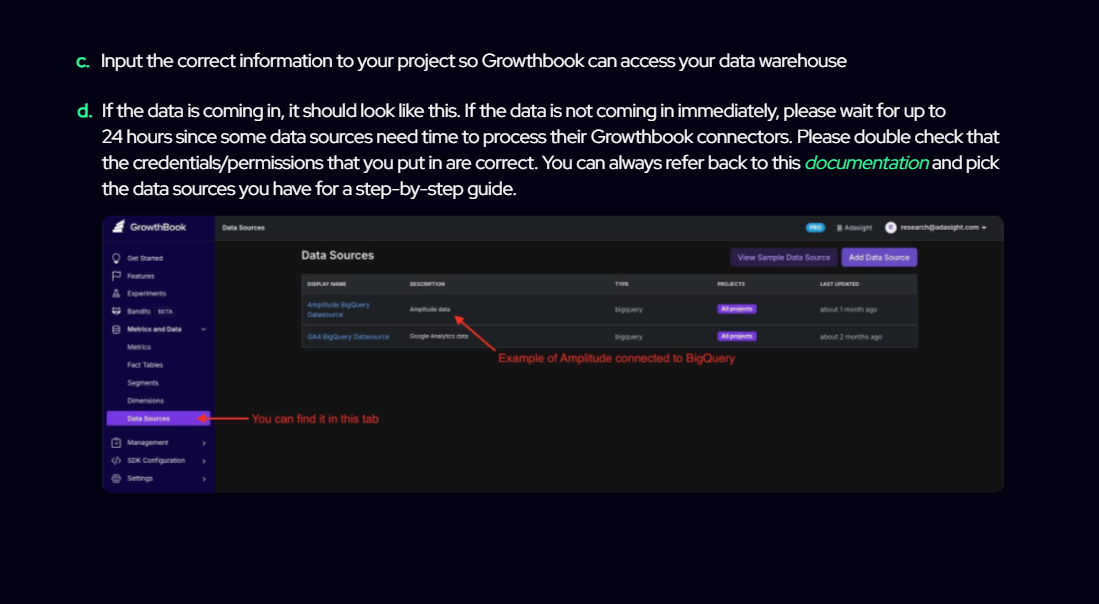
The first step is connecting GrowthBook to your chosen analytics platform. The Playbook walks through the integration step by step — including specific instructions for connecting Amplitude, so you don't have to piece it together from scattered documentation.
Connecting your data warehouse
This is the most critical technical step. GrowthBook needs access to your data warehouse to read experiment results. The Playbook covers setup for both BigQuery and Snowflake — including how to configure the connection, set the right permissions, and validate that data is flowing correctly before you run your first test.
Setting up your first experiment
Once GrowthBook is connected, you'll learn how to configure an experiment from scratch — defining your hypothesis, setting up feature flags, splitting traffic, and making sure the right events are being tracked for analysis.
Understanding experiment results
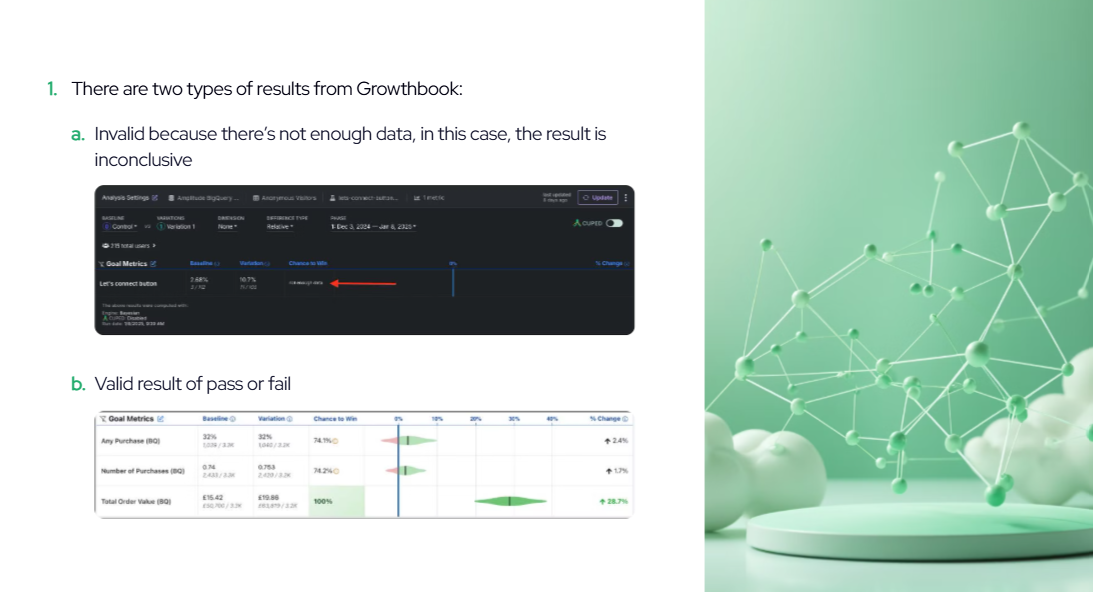
Running the experiment is only half the job. The Playbook covers how to read and interpret results correctly — including statistical significance, confidence intervals, and how to avoid calling a winner too early.
Rolling out successful experiments
If an experiment wins, you need to roll it out cleanly as the default experience for all users. The Playbook walks through how to do this in GrowthBook without disrupting users who were already in the experiment.
Ready to start experimenting with GrowthBook?
The GrowthBook Experimentation Playbook gives you the complete setup and execution framework: from connecting your data warehouse to interpreting your first results.
Download the free GrowthBook Playbook →
FAQ
What is GrowthBook used for?
GrowthBook is an open-source platform for running A/B tests and managing feature flags. It doesn't collect data itself — it reads from your existing analytics stack via a connected data warehouse to evaluate experiment results.
Does GrowthBook work with Amplitude?
Yes. GrowthBook integrates with Amplitude by connecting through a data warehouse like BigQuery or Snowflake. Amplitude sends event data to the warehouse, and GrowthBook reads it to analyse experiment outcomes.
Do I need a data warehouse to use GrowthBook?
Yes. GrowthBook requires a data warehouse connection to function. It supports BigQuery, Snowflake, Redshift, and other major warehouses. Without this connection, GrowthBook cannot evaluate experiment results.
How is GrowthBook different from Amplitude Experiment?
GrowthBook is open-source and warehouse-native, meaning it relies entirely on your existing data infrastructure. Amplitude Experiment is a native feature within the Amplitude platform. GrowthBook is typically preferred by teams that want more control over their data layer or are already invested in a warehouse-first stack.
Is GrowthBook free?
GrowthBook has an open-source version that is free to self-host. It also offers a cloud-hosted version with a free tier and paid plans for larger teams. The Playbook covers the setup process for both.
.png)